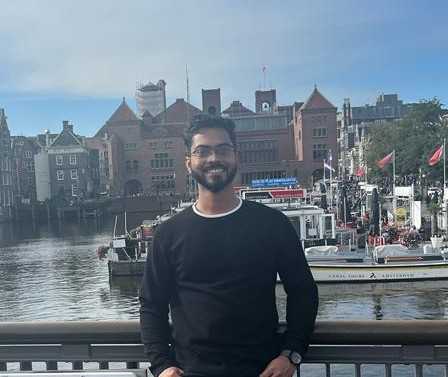
I’m a PhD student in Mechanical and Aerospace Engineering at Arizona State University, working with Prof. Kunal Garg in the Safe Robotics Lab. My research is about getting learned controllers to respect hard safety constraints — not on average and not most of the time, but as a property you can rely on once the robot is actually deployed.
Most of my current work sits between control barrier functions and sequence models. In BarrierFormer (CoRL 2026) a transformer enforces barrier constraints predictively: instead of reacting at the edge of the safe set, it anticipates violations over a horizon and acts early, removing online optimization at inference. A second project, FIND-R, asks what to do when a network does behave unsafely — we probe internal representations to localize the failure and repair that part directly, rather than retraining the whole policy.
Before the PhD I spent five years at TCS Research in Mumbai, building reinforcement learning systems for infrastructure that isn’t allowed to fail: power grids under adversarial attack, multi-robot task allocation, and railway scheduling. The recurring problem is the one I still work on — a combinatorially large action space paired with constraints a policy must never violate.
I’m now extending this to distributed multi-robot teams working under limited and delayed communication, where safe control and the health of the communication network determine each other: a team should anticipate degrading links and failures and reconfigure around them without a central coordinator.
News
- Sep 2026 — BarrierFormer: Transformer-Guided Predictive Barrier Enforcement for Safe Robot Control accepted at CoRL 2026 (main track).
- Aug 2026 — PRIORITY-Q: Certifiable Event-Queue Scheduling for Real-Time Railway Resource Allocation accepted at ICONIP 2026 (main track).